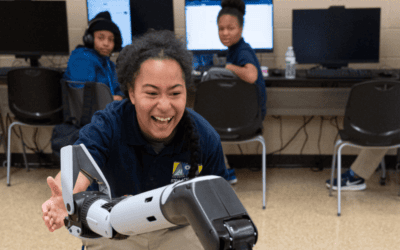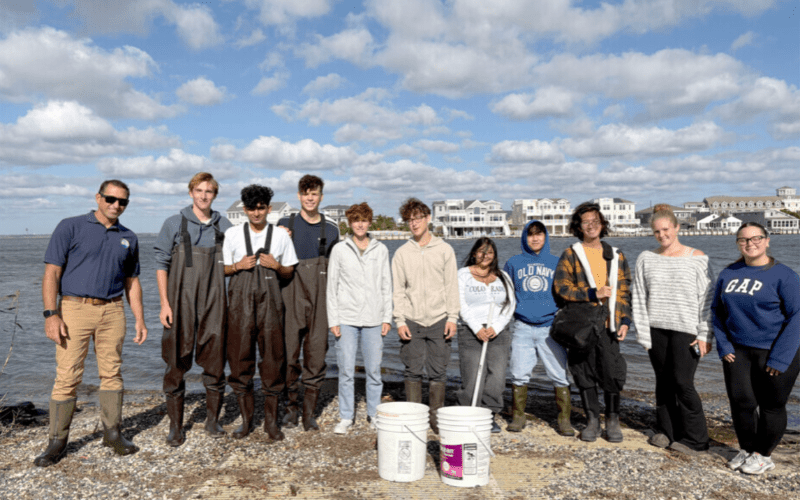
Field experiences are a vital part of the curriculum at MATES. Students and staff enjoy the opportunity to build connections between the classroom and the environment. Photo credit: Kathryn Coulibaly, NJEA.
On a beautiful but blustery day during the 2025 hurricane season, about 25 students huddled together for protection against the wind on an otherwise empty beach on Long Beach Island, listening to Dave Werner explain saltation as Hurricane Humberto raged offshore.
Werner teaches oceanography and environmental science at the Marine Academy of Technology and Environmental Science (MATES), one of the career academies administered by the Ocean County Vocational Technical School District (OCVTS).
MATES is located in Manahawkin, the primary mainland town before crossing Manahawkin Bay and entering Long Beach Island, an 18-mile barrier island known for its diverse ecosystems. Long Beach Island is a critical habitat for shorebirds and marine life. The southern tip of the island includes a portion of the Edwin B. Forsythe National Wildlife Refuge, an important stopover on the Atlantic Flyway for migratory birds. The island is famous for its beaches, but its dunes and marshes are also home to countless species.
Werner and the students have bused over from MATES to observe the impact of Humberto on the environment. They discuss the impact of the storm on the waves, the sand and the wildlife.
Back on the bus, the class moves to the bay, which is markedly calmer, where students in waders grab the seine net to collect species for the class. After several passes, they have buckets teeming with silver sides, baby blue crabs, comb jelly, northern pipe fish and shore shrimp.
“Nothing is more powerful than bringing students out of the classroom and into the field to practice what they are learning,” Werner says.
That’s the philosophy at MATES. With a focus on marine and environmental science and an enviable location on the Jersey shore, students here are able to put into practice what they learn in the classroom.
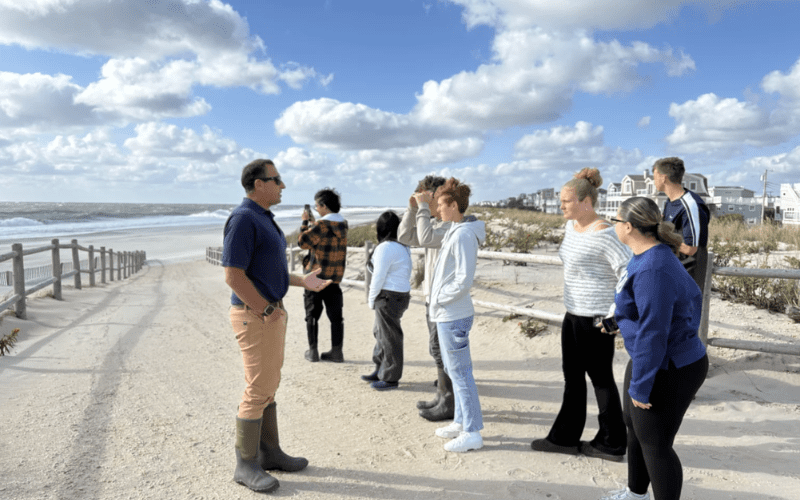
Oceanography and environmental science teacher Dave Werner instructs Marine Academy of Technology and Environmental Science (MATES) students as Hurricane Humberto raged off the coast. Photo credit: Kathryn Coulibaly, NJEA.
Research is the focus
Students are encouraged to engage in extensive fieldwork, independent research, work-based learning experiences and STEAM-based partnerships that enable them to explore a variety of career fields while developing practical skills and a deep understanding of how the work of the classroom is related to the world outside its doors. Every freshman is required to complete a research project. Upper-level students help mentor them, and many students continue that research throughout their time at MATES.
Adam Sprague, a teacher of biology, biotechnology and environmental science, grew up in the Florida Keys, working on shrimp and clam farms. He believes the district attracts the kind of teachers who are not only knowledgeable and passionate about their areas of expertise, but who are also actively engaged in living the material.
“The teachers here are top-notch,” Sprague says. “They bring a lot of unique experiences outside the classroom back to the students. I enjoy hiking in the Pine Barrens and that informs the work I do with the students on soil science and dendrochronology. We really benefit from our location.”
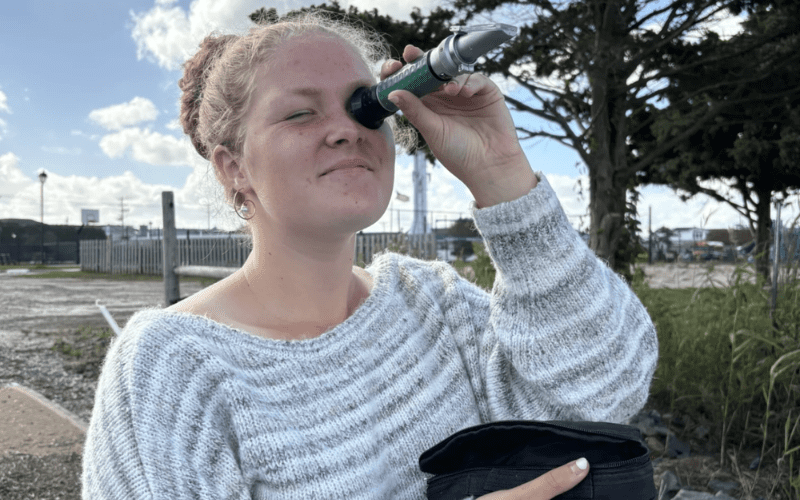
A student uses a refractometer to test the salinity of the water. Photo credit: Kathryn Coulibaly, NJEA.
The value of fieldwork
Dr. Amy Williams teaches biology, research methods and aquatic ecology at MATES. Because MATES is a magnet school that students must apply for, she sees a difference in their desire to learn. But she also sees the field work component of their education as vital to motivating them.
“We have a field bus each week where we take students out to collect samples,” Williams says. “When we’re back in the classroom looking at samples, the students know that they’re the ones who went out into the bay to collect them.”
The fieldwork also keeps staff invested in the work they’re doing.
“In other schools, people might get burned out by doing the same things, the same ways, year after year,” Williams says. “It’s so important for educators to get out into the field and explore. Every time we go out there, we see something new swim or fly by.”
The students’ enthusiasm also feeds into educators’ satisfaction with the work they are doing.
“We roll with their excitement because it might be the first time some of these students have gotten out to explore the environment around them,” Williams says. “We also find that by initiating these experiences for them, they start building connections between what they’re doing on the weekend and what we’re doing with the classroom.”
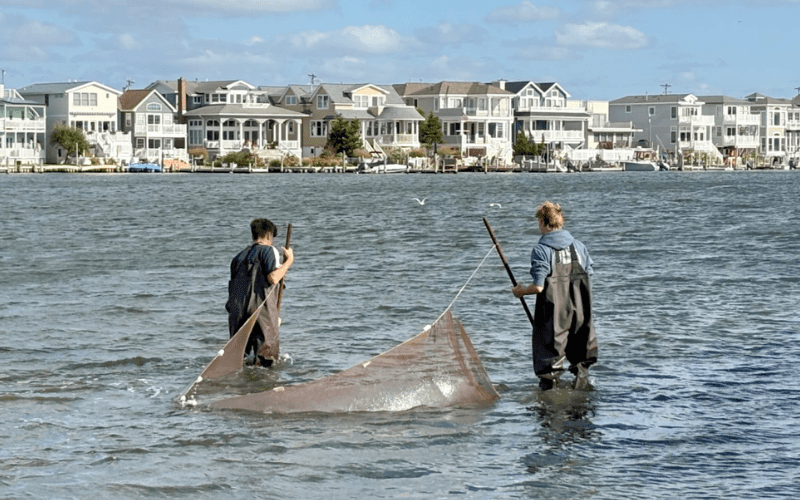
A student uses a refractometer to test the salinity of the water. Photo credit: Kathryn Coulibaly, NJEA.
Experts and activists in their fields
The staff is proud of the work they do with their students, but many are also engaged at high levels with environmental and activist organizations outside the classroom. There are no sports at MATES, only academic clubs and activities. Williams is the president of the New Jersey Marine Education Association and is on the board of Alliance for Living Ocean and Save Barnegat Bay.
Werner and Sprague have been the advisers for MATES’s Envirothon Club since 2004. The New Jersey Envirothon is a hands-on natural resources problem-solving competition. Students compete in various areas, including aquatics, forestry, soils, wildlife, team presentation and a current environmental issue.
“The Envirothon is an incredible competition that engages students in learning firsthand about the environment,” Werner says. “And it’s so much fun. We have won the state Envirothon competition 12 times and represented New Jersey in the National Conservation Foundation (NCF) National Envirothon in the United States and Canada.”
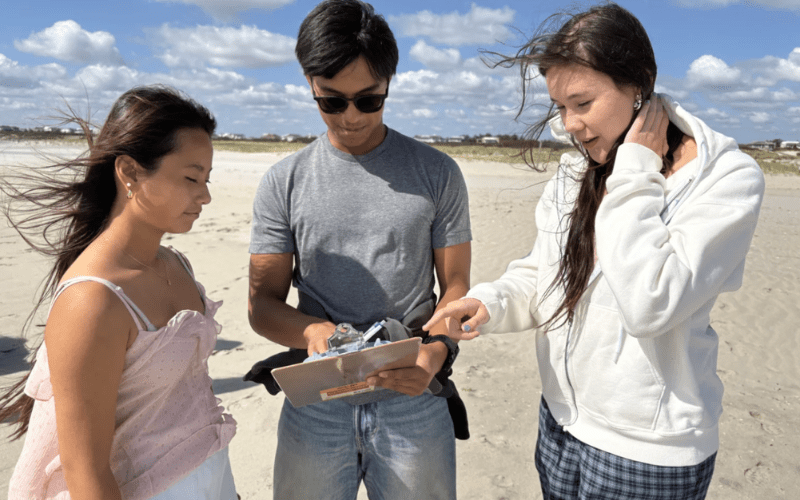
Students were asked to observe and document long period wave energy from the hurricane. Photo credit: Kathryn Coulibaly, NJEA.
Project Terrapin
One of the best examples of the intersection of educator expertise and the unique qualities of New Jersey’s environment is the work of John Wnek.
Wnek is one of the trailblazers who created MATES. He began developing a marine and environmental science curriculum in the 1990s, and recruited many of the current staff, yet is probably best known for his work protecting the diamondback terrapin. The diamondback terrapin is a species of turtle found in brackish coastal waters. They are vital to maintaining the health of salt marsh ecosystems, yet they face numerous threats. Wnek founded Project Terrapin to better understand and protect the species.
Wnek and his student volunteers conduct extensive fieldwork, monitor nesting sites, collect data on nesting behaviors and study environmental factors that influence reproductive success. By identifying critical nesting areas and threats, the project has informed conservation strategies that have improved outcomes for terrapin populations in New Jersey.
The future of environmentalism
MATES graduates go on to pursue a number of career paths. In 2025, 100% of its graduates were accepted to top colleges and universities. Students go on to work in fields that include marine and environmental science, engineering, computer science, math, medicine and much more.
“MATES provides students with incredible opportunities to advance their interest in the science fields and beyond,” Werner says. “The students leave MATES with more hands-on experience and higher-level critical thinking skills.”
This article originally appeared Mar. 27, 2026 in NJEA. It is authored by Kathryn Coulibaly, associate director of the Communications Division. She can be reached at kcoulibaly@njea.org.