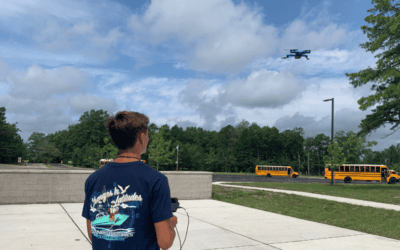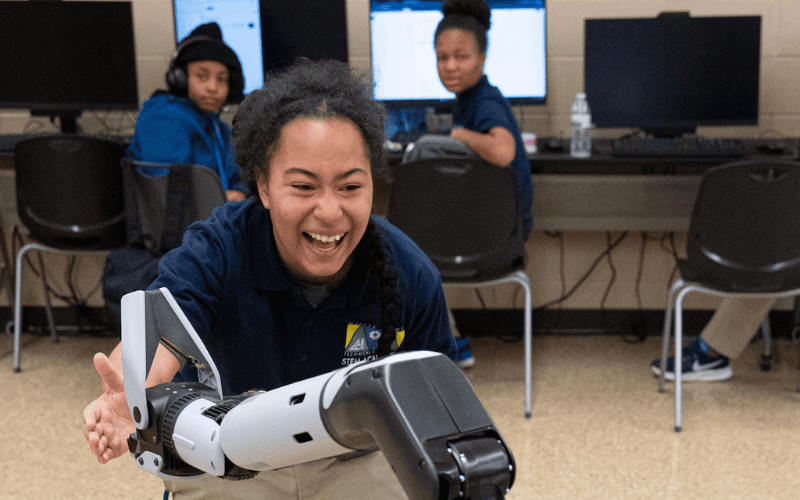
Students are learning robotics, machine learning and programming alongside lessons about bias, privacy, equity and ethics.Mercer County Technical Schools
How AI impacts our future is up for discussion.
As part of a new federal initiative, tech leaders from Anthropic, Meta, OpenAI, Google and other companies have joined the Super Intelligence Force to advance America as a leader in artificial intelligence. Their invitation came with a request from the White House to ceremonially sign an AI safety pledge, morally binding them to developing and using AI safely and responsibly.
The push and pull between innovation and safety continues to dominate these high-level conversations. But educators in New Jersey are already working to strike the right balance.
Our county vocational-technical school model has empowered schools to pool resources, consult with industry and higher education partners and thoughtfully develop curricula for new career programs that blend AI and robotics.
Both Mercer County Technical Schools and Middlesex County Magnet Schools received funding from the New Jersey Department of Education through an Expanding Career Pathways in Artificial Intelligence grant to lead the way.
Teaching the technology — and its consequences
At Mercer County Technical Schools, the four-year AI program provides high school students with a strong foundation in AI, robotics, machine learning, deep learning, augmented and virtual reality and Python programming.
It also includes an entire unit on ethics, engaging students in discussions about the moral and societal questions arising from the rapid development and deployment of AI technologies.
Acting Superintendent Charles Powell explained that students explore topics ranging from algorithmic bias and privacy concerns to the relationship between humans and machines. Through those discussions, students develop a critical awareness of AI’s benefits and risks so they can participate — and soon lead — in shaping an equitable and ethical AI-powered future.
At Middlesex County Magnet Schools, the new AI and Robotics program was shaped by Director of Career and Technical Education Lee Neamand, who worked closely with Patricia Morreale, professor and chair of the Department of Computer Science and Technology at Kean University.
Together, they built the curriculum around five ethical principles:
- AI enhances rather than replaces human teaching and learning.
- Educators and students maintain agency and control.
- AI use is transparent and explainable.
- Student data is protected.
- AI tools promote equity and access for all learners.
The goal is for Middlesex students to acquire both technical skills and ethical literacy. Students are empowered to create AI, manipulate AI and solve problems using AI, but never to use it without critical evaluation or as a substitute for critical thinking.
Schools must model responsible AI use
As schools prepare students to responsibly use and create AI, they are also revisiting their own policies and practices to model responsible use as educators and professionals. Many schools have crafted acceptable-use policies for AI and committed to continuous professional development on the technology.
The NJ Council of County Vocational-Technical Schools, which supports collaboration among all 21 county vocational-technical schools in New Jersey, recently held a professional development day for school leaders and educators focused on using AI in education with a clear, thoughtful strategy.
Our county vocational-technical schools are well-positioned to build a pipeline of talented young professionals who can contribute to both innovative and ethical AI practices. The strength of these schools comes from a culture in which partnerships and collaboration drive advances and keep career programs relevant.
Preparing the people who will shape AI
In that spirit, the NJ Council of County Vocational-Technical Schools encourages even more collaboration.
Educators must work together to ensure New Jersey students become the AI leaders of the future — leaders we can trust to move us in a direction that benefits humanity.
Any plan for the future of AI is shortsighted if it does not include educating the generations who will soon enter the workforce and apply AI technologies in their industries. Some will take on roles in which they directly build, train or govern AI.
Please join us in shaping the future of AI — and the future leaders who will work with these cutting-edge technologies.
Our county vocational-technical schools welcome opportunities to work with new partners who can bring additional insight to the lessons and discussions about AI happening in our classrooms.
Those of us in education, especially career education, understand the tremendous responsibility of this profession. Our mission is to prepare students to enter the modern workforce, contribute meaningfully and make a positive impact.
By staying at the forefront of AI education, we also have an opportunity to set the tone for ethical innovation.
This article originally appeared Oct. 11, 2026 in NJ.com and The Star-Ledger It is authored by Jackie Burke, executive director of the New Jersey Council of County Vocational-Technical Schools.