Want to solve a problem or complete a task more efficiently? A group of high school students might be able to help … using a drone.
From tracking field conditions for farmers to surveying event spaces for security personnel, drones have a range of uses across just about every industry. And as the technology continues to evolve, drones will become even more important for improving the operations of countless organizations.
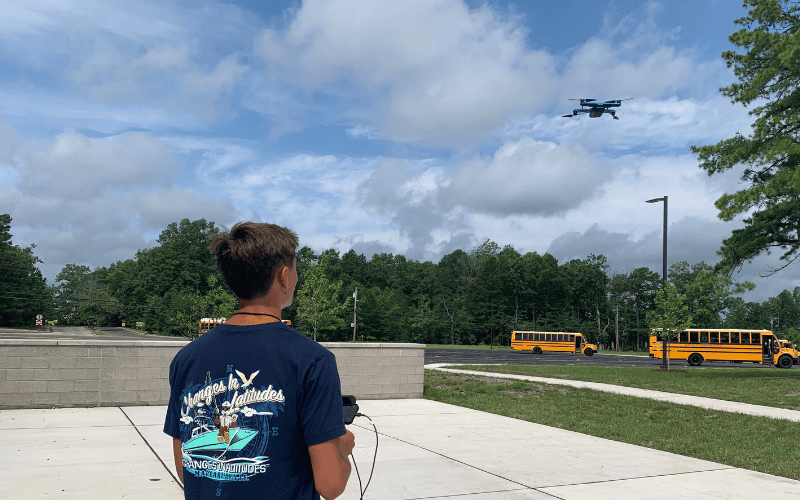
Aviation students at Atlantic County Institute of Technology are already imagining innovative ways to apply drone technology as part of their high school curriculum. The students have the unique opportunity to pursue an Uncrewed Aircraft Systems track within their Aviation Studies career program. Completion of the track includes the Federal Aviation Administration Part 107 Remote Pilot License and prepares the students to lawfully and effectively employ their UAS in the National Airspace System.
“When our students obtain a drone license, they open themselves up to opportunities for work-based learning in our community and throughout the state,” said Andrew Nebl, aviation instructor at ACIT.
There’s a drone for that
Nebl said about 10–15 of his students annually obtain their commercial drone license and are available for hire. As students, they have access to ACIT’s drones to sign out and use for a project.
Nebl encourages interested companies and organizations to reach out to him to discuss potential projects or positions for his licensed students. He also helps students think entrepreneurially and propose their own novel ways to apply drone technology.
As part of a two-phase project, he first asks, “How do we employ UAS for existing businesses that do not currently have the capability?” Nebl explained, “We like to think through ways to integrate UAS into a local business and then work to make it a reality, whether we are supporting services or finding ways to generate more revenue.”
One student’s idea was to use drones for food delivery in the shore town of Brigantine. That idea is in line with a movement to use drones for small package deliveries. An example is Amazon’s plan to expand its Prime Air Drone Delivery service to nearly 500 U.S. cities and towns by the end of this year.
Another student’s idea, which has since come to fruition, involved using a drone to capture imagery for marketing and to monitor growth at Tuckahoe Turf Farms, one of the largest growers of sod in the Northeast. The student’s family operates the Turf Farms, so even after graduation, he continues to find ways to use drone technology to benefit the business. And the possibilities are seemingly endless: capturing images to promote turf sales; monitoring irrigation to detect breaks early on; and tracking sod growth using advanced payloads, such as scanners or lasers for mapping and land surveying and thermal cameras to detect variances in irrigated land.
An upskill in any industry
Aviation students at Atlantic County Institute of Technology are imagining innovative ways to apply drone technology as part of their high school curriculum. – PROVIDED BY ATLANTIC COUNTY INSTITUTE OF TECHNOLOGY
The second part of Nebl’s project asks students to consider, “How do we use UAS in a creative way that does not currently exist in an industry?” Nebl admitted that after seven years of giving students this same prompt, it is becoming increasingly difficult to propose uses for drones that have not yet been explored. But over the years his students have shared ideas ranging from using thermal drones to monitor irrigation across golf courses to using drones to tag wildlife and support public safety.
“I was especially interested in the projects using drones to support public safety because, through conversations with our advisory board members from our Law and Public Safety program, I’ve seen tremendous opportunity to expand the use of drone technology among local and county public safety agencies,” said Karen Arcidiacono, director of career and technical education and special projects for ACIT. “While larger departments have begun integrating this technology, there is significant potential to broaden its application across our region.”
Arcidiacono has since begun exploring integrating the UAS coursework into the Law and Public Safety program to introduce another skill and high-level certification for these students to acquire.
‘Higher’ education
Such cross-training already occurs in ACIT’s Media and Graphics career program. Students enrolled in this program can opt to take the UAS coursework and earn their commercial drone license. Nebl said the partnership is ideal, with the Media and Graphics students bringing new skills and innate talents to projects requiring a creative eye.
“I can teach them to fly, but they know the angles they need when taking images and how to assemble everything into one package,” he added.
With drone videos and photography becoming standard in real estate marketing, empowering these Media and Graphics students with drone licenses gives them even more career opportunities to pursue. “We are offering ACIT students across a few career programs now a unique upskill – one that will make them more marketable as an employee or give them a chance to have their own ‘gig’ on the side,” added Arcidiacono.
Arcidiacono credited ACIT’s partnerships with the Atlantic County Economic Alliance, the FAA and the National Aviation Research and Technology Park with helping ACIT develop highly specialized programs in aviation that enable students to meet local workforce needs in Atlantic County and well beyond.
Nebl added that his students also will be well-positioned to fill emerging workforce needs in counter UAS.
“The government put resources toward this and invested in counter UAS training for the World Cup,” said Nebl. “We’re just at the beginning of exploring this, but our students know how to operate UAS, so they are in a good position to help guard against it, too.”
Interested?
Need a drone for a project? To enlist the help of Nebl and his students, email anebl@acitech.org and Gina DeMaio, work-based learning coordinator, at gdemaio@acitech.org. Students are available for extended work-based learning positions or individual projects using drones.
Interested in drone certification? ACIT offers a UAS course for adults in addition to the track in the four-year high school Aviation Studies program. Interested adult students can call (609) 625-2249 ext.1021.
This article originally appeared Sept. 14, 2026 in NJBIZ. It is authored by Jackie Burke, executive director of the New Jersey Council of County Vocational-Technical Schools.