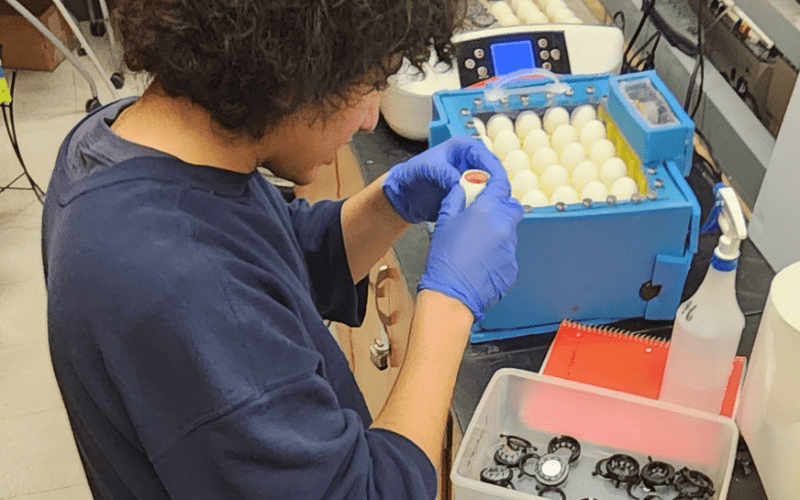
Bergen County Academies alumnus Muhammed El-Sherbiny performs research inside eggs using an entire system he designed to transform chicken eggs into research models using lasers to cut into the shells while preserving the eggs’ protective membranes.
An “idea vault” maintained by Bergen County Academies instructor Carlos Nodarse preserves 14 years of students’ inventions, complete with instructions for how to build them. As a research mentor in the school’s Mechatronics Research Laboratory, Nodarse welcomes students from across Bergen County Technical Schools to bring their ideas into the lab and take a research elective. “I encourage them to build something for humanity — no matter how small,” he said.
Last year, he mentored a culinary student who developed a boot to control edema, a condition that plagued a family member. That student bested peers across science disciplines to win the district’s science expo, and he went on to attend the Regeneron International Science and Engineering Fair.
Nodarse said he began filling the idea vault years ago after a student built a device to aid deaf drivers. The device picked up emergency vehicle frequencies and conveyed that information to the driver through vibration and a digital display under the rearview mirror. When the student presented at the New Jersey Regional Science Fair, the father of a deaf child asked to purchase the device.
“We were unable to produce it for sale, but I thought I could work with the student to give the father instructions to build it himself,” Nodarse explained. “We did it, and because of that experience, we started including instructables as part of each research project and created the idea vault.”
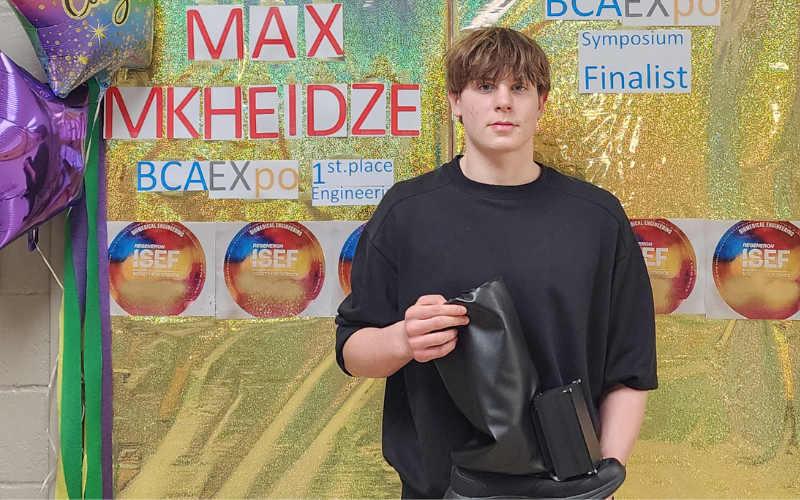
Bergen County Technical Schools alumnus Maximilian Mkheidze studied culinary arts in high school, but took advantage of the opportunity to take an elective in the Bergen County Academies Mechatronics Research Lab. He developed a boot to treat edema, ultimately discovering a passion and talent for engineering. He was accepted to the Cornell School of Engineering.
Hatching ideas
Over the years, Nodarse has been part of student projects that have even secured patents, with a recent project in the patent review process. That work belongs to 2024 Bergen County Academies graduate Muhammed El-Sherbiny and includes an entire system designed to transform chicken eggs into research models by using lasers to cut “windows” into the shells.
This method enables the egg’s protective inner membrane to remain intact, allowing the embryo to stay alive during research studies while researchers inject treatments and monitor development. El-Sherbiny initially approached Nodarse with his vision, understanding the implications of pulling off such a feat, which balanced the simplicity of a lab dish with the complexity of a living organism, that could make testing drugs for diseases much easier and more effective.
El-Sherbiny won the Regeneron ISEF 2023 Grand Award in Biomedical Engineering for an early prototype. From there, he continued refining and adding elements, including testing kits, a quad laser to hold and cut four eggs at once, and an incubator with a camera system to monitor experiments run inside multiple eggs.
El-Sherbiny won the Regeneron ISEF 2023 Grand Award in Biomedical Engineering for an early prototype. From there, he continued refining and adding elements, including testing kits, a quad laser to hold and cut four eggs at once, and an incubator with a camera system to monitor experiments run inside multiple eggs.
Nodarse worked with El-Sherbiny on the project for nearly four years, pouring thousands of hours into it. They used mostly recycled materials – a priority in the Mechatronics Research Laboratory – to turn El-Sherbiny’s ideas into working prototypes that have the potential to change scientific research forever.
“Bergen County Academies incorporates research opportunities into the curriculum, because we know our students come to us highly motivated to make meaningful contributions in the fields they’re pursuing,” said Bergen County Technical Schools Superintendent Howard Lerner. “We help students build a foundation through their learning and offer a range of resources, including dedicated staff, but the students take control to bring their ideas to life. It’s remarkable, year after year, to see what they can accomplish before graduating high school.”
Student-led cancer study
Just this year, Bergen County Academies had the third-highest number of semifinalists and highest number of finalists nationally in the Regeneron Science Talent Search, which largely evaluates students based on the originality and creativity of their research.
Senior Uyen Tran is among the school’s semifinalists for her research examining the role of sex hormones in lung cancer. Using human lung cancer cells grown in the school’s Bioresearch Lab, she tested how estrogen and a commonly used anti-estrogen drug affected cancer cell growth.
“Young female nonsmokers develop lung cancer at an increased rate than their male counterparts, and I wanted to explore why,” said Tran. In her review of existing research, Tran found evidence that the cancer progressed faster in women because of higher levels of estrogen. She built her study around targeting lung cancer cells with varying levels of estrogen and the anti-estrogen drug Tamoxifen.
Tran’s research mentor, Dr. Ericka Smith-Worley, said the school receives a combination of local, county, state and federal funding along with donations and grants to ensure the Bioresearch Lab is equipped with compounds, cell lines, and other materials and technology needed for such high-level research.
Over three to four years, Tran built and implemented her research study and noticed estrogen slowing cancer cell proliferation, which conflicted with much of what she found in published studies. She and Smith-Worley both acknowledged the study would need to continue for years to garner any conclusive results. They also said the findings highlight the complexity of cancer biology and reinforce the need for ongoing research.
An aspiring physician, Tran said she will seek continued opportunities to research lung cancer and emphasized, “It’s important to have foundational knowledge of why disease happens in the body.”
Changing the profession
Across New Jersey’s county vocational-technical schools, career programs in the sciences are evolving to prepare students not only to enter a profession but potentially change it. Passaic County Technical Institute demonstrated its commitment to innovation in the naming of its newest building, the John Currie Biotechnology Innovation Center.
Made possible with funding from the 2018 Securing Our Children’s Future Bond Act, the building opened last year for a focused, four-year biotechnology program. It includes New Jersey’s first DNA Learning Center operated in partnership with Cold Spring Harbor Laboratory.
“Having Cold Spring Harbor on campus is significant; the company is home to pioneers in DNA research and has had eight Nobel Prize winners,” said Michael Petruccelli, biotechnology program supervisor. “Our students and staff benefit from having access to their cutting-edge technologies and DNA labs just a floor away.”
Petruccelli said he anticipates the partnership further evolving as the first class of biotechnology students, who are now juniors, take on a Capstone research project next year. He explained the capstone research course is a requirement for any students who have been maximizing opportunities for dual credits and pursuing an associate degree while in high school.
Ready for research
“When students will be thinking about their own research next year, they will have the tools and skills already under their belts,” said biotechnology instructor, Dr. Ganna Osetska. “They will know how to approach a problem, structure the research, set controls, anticipate what could go wrong and troubleshoot to learn from failures as well as successes.”
Osetska explained that the program is effective because it delivers academics and skills simultaneously by having students following laboratory and documentation practices and using equipment. Such preparation through a learning-by-doing mentality is a hallmark of career and technical education programs.
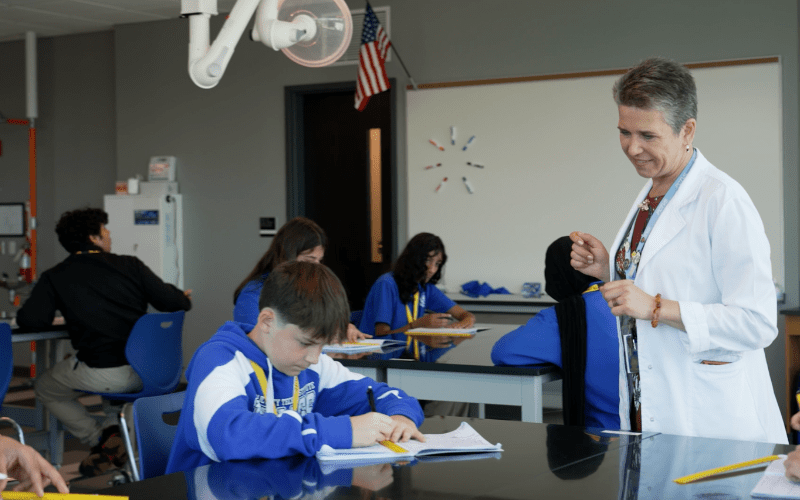
Dr. Ganna Osetska, a biotechnology instructor in Passaic County Technical Institute’s new John Currie Biotechnology Innovation Center, makes the most of a customized learning environment where students spend four years developing important research skills.
Early on, students also learn how to edit genetic material using CRISPR, “Clustered Regularly Interspaced Short Palindromic Repeats,” which Osetska said is a staple in the biotechnology industry. “CRISPR, in layman’s terms, is a molecular scissor system that enables scientists to find and edit DNA,” she explained.
Using this technology is likely how future PCTI biotechnology students will make their own impact on humanity.
“CRISPR is being used in medicine and biotechnology, and our labs are exposing students to a range of uses for CRISPR and preparing them to use the technology to solve a problem,” added Osetska.
This article originally appeared Feb. 23, 2026 in NJBIZ. It is authored by Jackie Burke, executive director of the New Jersey Council of County Vocational-Technical Schools.