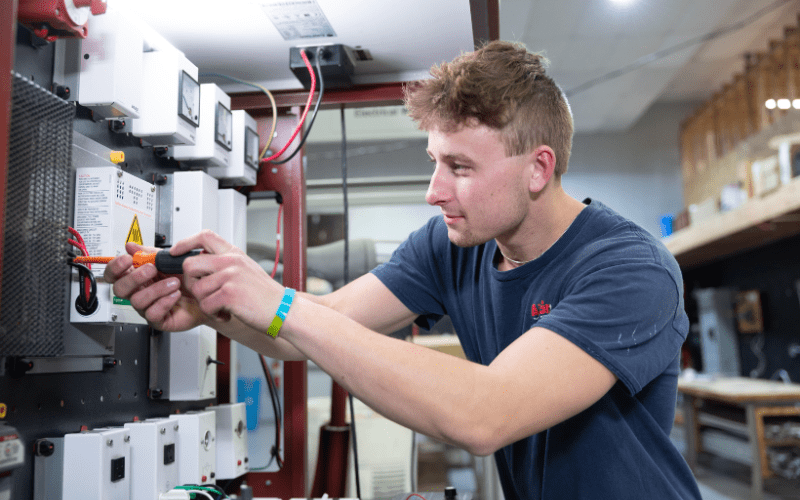
Morris County Vocational School District’s post-secondary programs include electrical apprenticeships. – PROVIDED BY MORRIS COUNTY VOCATIONAL SCHOOL DISTRICT
It’s never too late to change careers or even head back into the workforce after a pause. In fact, New Jersey’s county vocational-technical schools make it easy to do so with affordable and flexible career programs geared toward adult students. They also appeal to recent high school graduates who are pursuing careers that do not require college or see an opportunity to begin working as they consider further education.
Many of the post-secondary programs offered by Morris County Vocational School District are so popular that a line forms early on the first day of registration and snakes through the Denville campus. “It’s a huge event here,” said Assistant Principal Conor Devine, who oversees the district’s Adult and Continuing Education programs.
“Skills pay the bills, and with AI becoming more prevalent, this is especially true,” he added. “Many of our programs, especially our Apprenticeships, prepare students for secure futures. AI cannot do what our students are trained to accomplish in the workforce.”
Devine said the most sought-after programs (and the ones applicants line up for) are the Electrical, HVAC/R, and plumbing registered apprenticeships, which are approved by the New Jersey Department of Labor & Workforce Development. Seats for all three typically fill in less than an hour.
“The Department of Labor’s approval offers enrollees a security blanket; it’s a guarantee that the state will give them a journeyman’s license,” said Devine.
Critical Partners
Because Apprenticeships combine 150 hours of instructional time with on-the-job training, finding a willing employer to sponsor an Apprentice is critical, but it can be a challenge. At Morris County Vocational School District, Program Specialist Nory Urgiles offers students assistance in finding a sponsor as a well-connected Apprenticeship coordinator.
The support she provides is invaluable and contributes to a learning environment centered around forming relationships and building a network important for success both in the program and after.
“The connections our students make here benefit them for the rest of their lives,” added Devine. “When they enter an Apprenticeship program, they become part of a cohort that stays together for two or four years depending on the program. Classmates may one day become colleagues. Instructors and employers become mentors. Conversations are had, both formally and informally, that are often entrepreneurial in nature and inspire students to go on to own their own businesses.”
Explore Your Programs
At Burlington County Institute of Technology, Principal of Adult Education Andrew McAlpin, Ed.D., works to spread awareness of his school’s Adult and Continuing Education programs. Options range from Department of Labor-approved Apprenticeships to Dental Assisting and from Cosmetology to Veterinary Assisting.
“The biggest complaint I hear is, ‘We didn’t know you were here,’” he said.
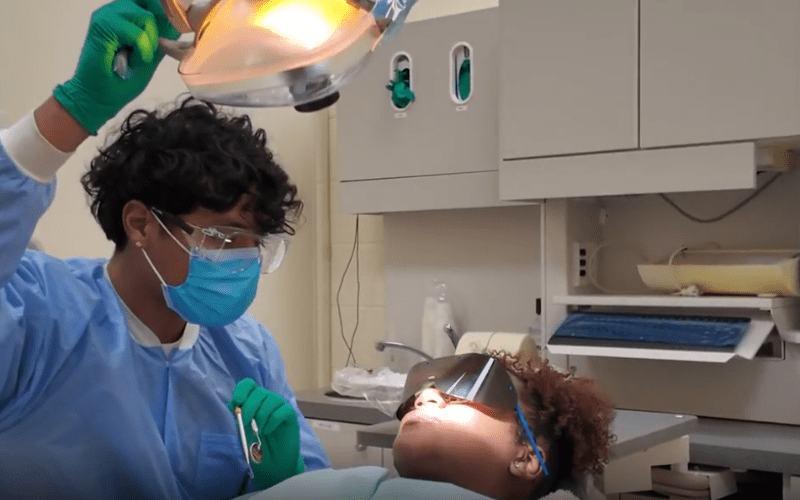
At Burlington County Institute of Technology’s Adult and Continuing Education programs, options range from Department of Labor-approved apprenticeships to dental assisting and from cosmetology to veterinary assisting. – PROVIDED BY BURLINGTON COUNTY INSTITUTE OF TECHNOLOGY
Since becoming principal two years ago, McAlpin has worked to close that awareness gap. When he started in the administrative role, enrollment was just under 300 students. With the recruitment of new teachers and the addition of new programs, BCIT now serves nearly 800 students through its Adult Education division.
“I coined the phrase ‘technical test drive,’” he said. “I say to anyone with interest in our programs to come out, visit us, get behind the equipment, sit in a career classroom and participate for a day. That’s been a hit.”
McAlpin says BCIT’s doors are open to everyone, from newly graduated high school students to adults who have had a long career and seek a change. He encourages interested students to ponder what he refers to as the “3 Fs.”
“What fits your needs, what feels right and what matches your financial situation?” he asks them.
“Sometimes our programs may be a starting point, but they are a smart starting point, because many of the skill sets students acquire are cross-curricular and cannot be performed by AI,” McAlpin added. “We will always need people to use their hands to install, build and create. We will always need a human touch in healthcare.”
Launch a Career
With opportunities always in abundance in healthcare, the Adult Education Allied Health Occupations programs are especially booming at BCIT. The school recently started an evening Licensed Practical Nursing (LPN) program in addition to the daytime offering. The Certified Nurse Aide (CNA) program also offers flexibility with day and evening course options and has an established partnership with BAYADA Home Health Care for students to gain clinical hour requirements and important experience as they prepare for the CNA licensing exam and even the home health aide exam.
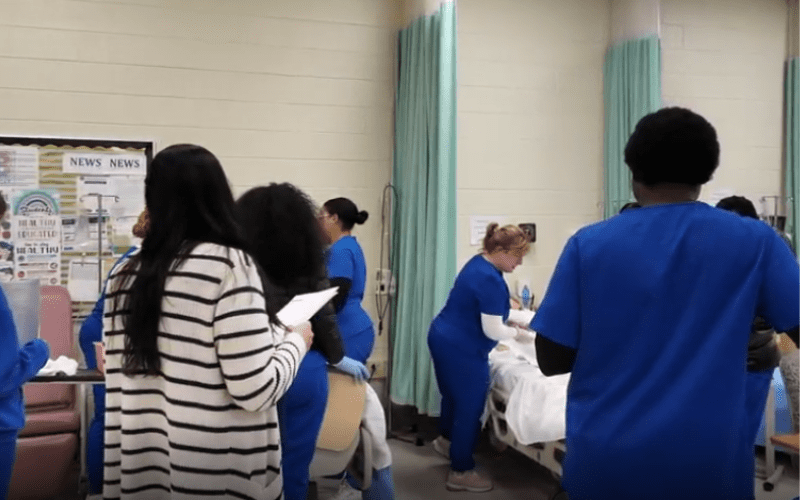
Burlington County Institute of Technology recently started an evening Licensed Practical Nursing program in addition to the daytime offering. – PROVIDED BY BURLINGTON COUNTY INSTITUTE OF TECHNOLOGY
BCIT also has a well-equipped space for teaching Dental Assisting and offers a Dental Radiology add-on course. Students have access to the same equipment used in dentist offices to practice and prepare for a seamless transition into the workforce.
“BCIT is among a select few CODA-certified programs,” explained McAlpin, referring to the Commission on Dental Accreditation. “When students complete our program, they have their New Jersey Registered Dental Assistant registration; they are able to perform expanded functions that most dental assistants cannot do without first training for three years under a dentist.”
Even with a student body of nearly 800, BCIT still has waiting lists for many of its Adult Education programs. Much like MCVSD, expansion is largely dependent on finding qualified and passionate professionals to teach what they know.
Anyone interested in giving back and becoming an instructor can reach out to their local county vocational-technical school for more information. Adult Education instructors do not need to meet the same requirements as high school career and technical education instructors.
Register and Learn
Now is the time to start planning and looking into enrollment deadlines for many adult career programs beginning in the Fall.
To view Adult Education offerings across New Jersey’s county vocational-technical schools, visit https://careertechnj.org/adults/. Most programs welcome students from neighboring counties.
Specifically for Morris County Vocational School District Adult and Continuing Education, registration opens on Monday, August 3 for most offerings with a Fall start, including Apprenticeships. Some programs, such as the Licensed Practical Nursing (LPN), have a different timeline and require a pre-assessment.
To learn more about the program offerings, application requirements and timelines, and tour opportunities, call Ms. Urgiles at 973-627-4601 ext. 208.
A full catalog of post-secondary programs offered in Fall 2026 will be available in mid-June at mcvts.augusoft.net.
Specifically for Burlington County Institute of Technology Adult Education, enrollment is currently open for programs starting in the Fall. Visit https://www.bcit.cc/o/bcitae to learn more and register.
To reach Dr. McAlpin directly, call 609-267-4226 ext. 8330.
This article originally appeared June 1, 2026 in NJBIZ.It is authored by Jackie Burke, executive director of the New Jersey Council of County Vocational-Technical Schools.